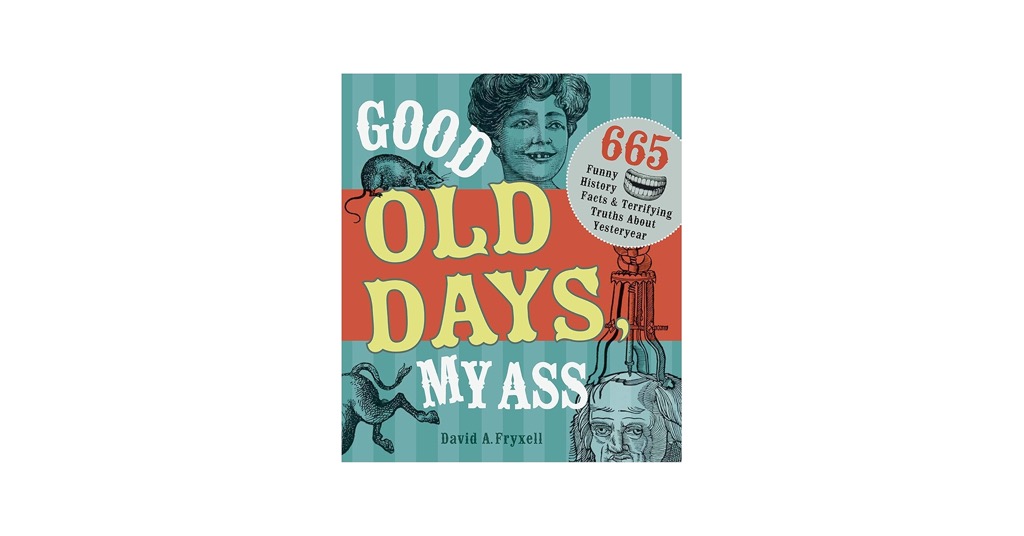
Good Old Days,
My Ass
665 Funny History Facts & Terrifying Truths about Yesteryear
by David A. Fryxell
★★★★☆ 4.2 stars · 132 Amazon reviews
✦ Welcome to the Not-So-Glorious Days ✦
Think the “good old days” were better? Think again. Buckle up for a bumpy ride through history as hundreds of funny — and terrifying — truths reveal the unfortunate reality of life in the 18th, 19th, and early 20th centuries. These horrors will leave you extremely grateful for the present.
Click any chapter to read a sample entry
Life in a State of Nature
Wild things and natural disasters
✦ Sample Entries ✦
Extinct? I'll show you extinct!
Residents of Pompeii thought Vesuvius, quiet for thousands of years, was extinct — right up until 79 AD, when it began raining hot ash at six inches an hour. A "fearful black cloud rent by forked and quivering bursts of flame" buried both Pompeii and Herculaneum beneath 15–20 feet of ash, killing 16,000 people.
Forecast: Blizzards, famine and riots
The 1815 eruption of Mount Tambora in Java turned 1816 into "the year without a summer." A June blizzard dumped 20 inches of snow on the northeastern US, killing frosts left fields barren, and English mobs armed with iron spikes and "Bread or Blood" signs looted towns in search of even a crust to eat.
Hang 'em High or Drawn and Quartered?
Crime and punishment through the ages
✦ Sample Entries ✦
Going to pieces
Public butchering — called lingchi — was an accepted method of execution in China until 1905. Authorities hauled the condemned into a marketplace and sliced off chunks of flesh, then removed the limbs, and finally the head. The Chinese had a special horror of dismemberment, fearing they would likewise be mutilated in the afterlife.
Anyone for a swim?
First used by the Dutch in 1560 and not abolished until 1856, "keelhauling" involved tying an offender to a rope looped beneath the ship, throwing him overboard, and dragging him along the barnacle-encrusted keel. Half-drowned and scraped raw, the wayward sailor was unlikely to repeat his offense.
Rats and Other Fashion Accessories
Style and beauty back then
✦ Sample Entries ✦
A deadlier shade of pale
As far back as ancient Greece and Rome, people lightened their complexions with makeup containing white lead — which can cause disfigurement and death. This deadly makeup remained fashionable into the Elizabethan era, when women applied ceruse — a compound of white lead and vinegar — in imitation of the queen's pallid skin.
Darling, who does your hair — and what lives in it?
The towering coiffures of the 18th century took so long to create that weeks went by between stylings. The mixture of lard, starch, and powder attracted rats and other vermin who found these high hairdos perfect for nesting. Some women wore cages over their heads at night — others embraced the idea and incorporated birdcages, complete with live birds, into their coiffures.
No Wonder They Call It the "Dismal Science"
Money and economics, the rich and (mostly) the poor
✦ Sample Entries ✦
Don't tell the IRS about this!
After the Vikings invaded Ireland beginning in 795, those who refused to pay the Vikings' "tax" got their noses slit — which is the origin of the phrase "pay through the nose."
Sip faster, while you can still afford it
At the peak of Germany's 1923 hyperinflation, a wheelbarrow full of money wasn't enough to buy a newspaper. One student ordered a cup of coffee, then a second. When the bill arrived it was nearly triple the menu price — the price had risen between cups. "If you want to save money," he was told, "you should order them both at the same time."
Cleanliness Is Next to Impossible
Sanitation and hygiene
✦ Sample Entries ✦
No corn on the cob for me, thanks…
Before toilet paper, almost anything that came to hand was employed for personal cleaning: stones, clay, sponges on sticks, mussel shells, fur — and yes, corncobs. In rural America, the outhouse was typically equipped with a box of corncobs, or in less persnickety homesteads, a corncob hung on a string, meant to be reused.
Banned in Boston: Bathing
Even into the 19th century, bathing was an oddity engaged in more for quack therapeutic purposes than cleanliness. In 1835, Philadelphia's Common Council missed by just two votes passing a ban on wintertime bathing. In 1845, Boston banned bathing entirely except when prescribed by a doctor.
No-Go
Transportation flops and detours
✦ Sample Entries ✦
The surrey with the fringe on top — and blood on the wheels…
Before the motorcar, horse-drawn vehicles brought constant carnage. In 1720, "furiously driven carts and coaches" were cited as the leading cause of death in London. As late as 1867 in New York City, horses caused an average of four pedestrian deaths per week.
From passenger to pedestrian to corpse
The first person killed by an automobile had, until an instant before, been riding in it. In 1869, Mary Ward, an Irish naturalist, was thrown from an experimental steam-powered vehicle on a sharp turn. She was crushed under the iron wheels, which broke her neck, and died almost instantly.
We Are Not Amused
Sports, recreation and what our ancestors called "fun"
✦ Sample Entries ✦
Lions, tigers and bears — oh my!
The Romans' appetite for exotic animals in sporting entertainment was so high that the army had a special position — venator immunis — for soldiers who procured animals. As audiences became jaded with ordinary species, the menu grew more exotic. During the inaugural games of the Colosseum in 80 AD, between 3,500 and 9,000 animals were killed.
Rome wasn't built in a day, but this stadium was…
In 27 AD, 50,000 fans jammed into a newly built stadium in suburban Fidenae — unaware that the builder had cut corners on the foundation. As spectators filled the seats, the stadium creaked, teetered, and collapsed in a chaos of broken timbers, bodies, and screams. Estimates of dead and injured range from 20,000 on up.
Ready to Be Horrified?
Thank your lucky stars you live in the present — then pick up the book that proves just how bad it used to be.